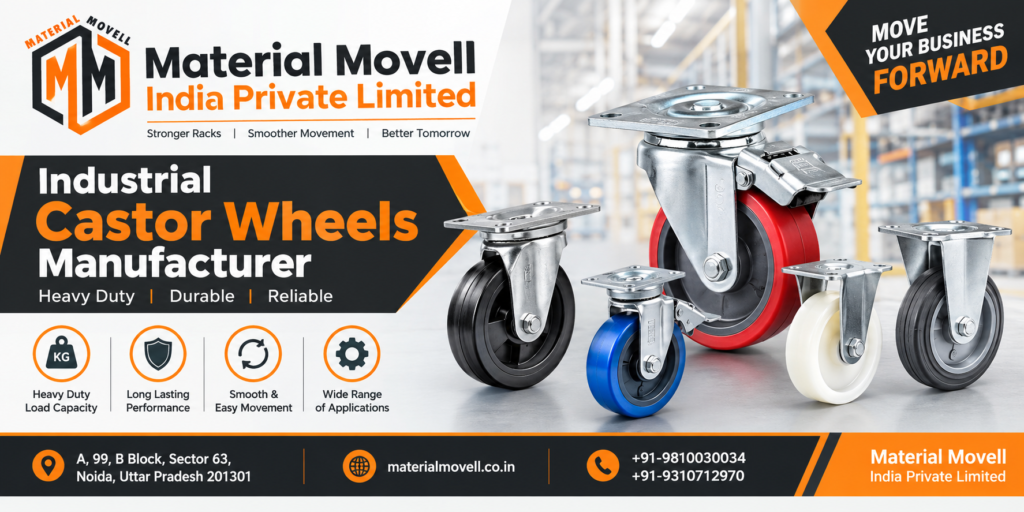
If a wheel fails under load, the cost is never just the wheel. It’s a stalled production line, a damaged floor, a spilled load, or an injured worker. That’s why choosing the right Industrial Castor Wheels Manufacturer matters more than most procurement teams realize — the wheel is a small component with an outsized impact on plant safety and uptime.
At Material Movell, we’ve been manufacturing heavy duty industrial castor wheels and trolley wheels in India since 1975, and we’ve seen firsthand how the right castor selection prevents downtime, reduces maintenance costs, and keeps material handling operations running smoothly. This guide walks through everything a factory owner, procurement manager, or maintenance engineer needs to know before buying industrial caster wheels — from load calculations to material selection to common failure points.
What Are Industrial Castor Wheels?
Industrial castor wheels are wheel-and-bracket assemblies designed to be mounted under trolleys, carts, workstations, machinery, and equipment so they can be moved with minimal effort. Unlike standard furniture or light-duty casters, industrial trolley wheels are built to carry significant weight repeatedly, across long shifts, often on rough or uneven factory floors, without breaking down.
A castor assembly typically consists of:
- The wheel — the load-bearing, rolling component (rubber, polyurethane, nylon, cast iron, or elastomer)
- The fork or yoke — the metal frame holding the wheel in place
- The top plate or stem — the mounting mechanism that attaches the castor to the equipment
- The bearing — enables smooth rotation and swivel movement
- The brake (optional) — locks the wheel for stability during loading/unloading
Every one of these components affects how the castor performs under load, and a weak link anywhere in this chain leads to premature failure.
Why the Right Manufacturer Matters More Than the Lowest Price
Many procurement teams shop industrial castor wheels purely on unit price. This is where most costly mistakes happen. A castor priced 15% lower but rated for a lower load capacity, made with inferior bearing steel, or using low-grade polyurethane, will typically fail within months in continuous-use environments — leading to replacement costs, unplanned downtime, and in worse cases, safety incidents.
A genuine industrial wheels manufacturer should be able to answer these questions confidently:
- What load capacity is this wheel rated for, and is it dynamic or static load?
- What raw material and hardness (durometer) is the wheel tread made from?
- What bearing type is used, and is it sealed against dust and debris?
- Can the castor be customized for specific floor types, temperatures, or chemical exposure?
- What is the expected service life under continuous industrial use?
At Material Movell, our castors are manufactured in-house across our Noida, Roorkee, and Greater Noida facilities — including an automatic CED (Cathodic Electro Deposition) coating plant for enhanced corrosion resistance on metal components. This vertical integration lets us control quality at every stage, from raw sheet metal and forging to final assembly, rather than outsourcing critical components to third parties.
Types of Heavy Duty Castor Wheels
Not aoor surface, speed of movement, and environmental conditions.
1. Fixed vs. Swivel Castors
- Fixed castors move in a straight line only and are typically paired with swivel castors on trolleys to maintain directional control under heavy loads.
- Swivel castors rotate 360° and allow multi-directional movement, essential for maneuvering inll heavy duty castor wheels are built the same way. Choosing the correct type depends on load, fl tight warehouse aisles.
2. Wheel Material Types
| Wheel Type | Best For | Key Property |
| Cast Iron / Steel | Extremely heavy static or slow-moving loads | Maximum load capacity, low rolling resistance |
| Polyurethane (PU) | General industrial and warehouse use | High load capacity, floor-friendly, quiet |
| Elastomer / Rubber | Uneven floors, shock absorption | Cushioned ride, noise reduction |
| Nylon | Chemical or moisture-heavy environments | Corrosion resistant, durable in harsh conditions |
| Cast Polyurethane on Aluminium Core (ALCPU) | High-load trolleys needing durability with lighter weight | Combines strength of metal core with cushioning of PU tread |
3. Spring-Loaded / Shock-Absorbing Castors
For applications where loads travel over uneven flooring, expansion joints, or dock plates, heavy load castor wheels with a spring-loaded or forged shocker mechanism absorb impact and protect both the load and the floor from repeated shock stress.
How to Choose the Right Industrial Castor Wheels
Selecting castors for industrial equipment correctly the first time avoids costly replacements later. Use this framework:
Step 1: Calculate the Actual Load
Add the weight of the equipment/trolley itself to the maximum expected load, then divide by the number of castors — but never assume equal weight distribution. As a safety margin, select castors rated for at least 25–30% above your calculated per-wheel load, since uneven weight distribution and dynamic movement (starting, stopping, turning) increase actual stress on individual wheels.
Step 2: Assess the Floor Surface
- Smooth epoxy or tiled floors → harder wheels (cast iron, nylon, hard PU) roll easier with less effort
- Rough concrete, gravel, or outdoor yards → softer wheels (rubber, elastomer) absorb shock and reduce vibration
- Wet or oily floors → non-marking rubber or PU with corrosion-resistant brackets
Step 3: Consider the Operating Environment
Temperature extremes, chemical exposure, and moisture all degrade certain materials faster. Industrial material handling wheels used in cold storage, for example, need wheel compounds rated for low-temperature flexibility, while wheels in chemical plants need corrosion-resistant brackets and non-reactive tread materials.
Step 4: Match Wheel Diameter to Movement Ease
Larger diameter wheels roll more easily over floor irregularities and require less pushing force — a critical factor for manual trolleys handled by workers across long shifts. Smaller wheels suit tighter spaces but increase rolling resistance.
Step 5: Decide on Braking Requirements
Any application involving loading/unloading, height-adjustable workstations, or use near ramps and inclines should include braked castors to prevent unintended movement.
Common Applications of Heavy Duty Wheels
Heavy duty wheels and industrial castors are used across nearly every sector that moves physical goods:
- Manufacturing plants — moving raw materials, WIP inventory, and finished goods between production stages
- Warehousing and logistics — trolleys, pallet movers, and storage rack mobility
- Automotive and heavy engineering — moving components, tooling carts, and assembly line fixtures
- Hospitals — equipment trolleys, bed frames, and mobile carts requiring quiet, smooth operation
- Hospitality — housekeeping and service trolleys needing durability with low noise
- Cold storage and food processing — corrosion-resistant, washdown-capable castors
- E-commerce fulfillment centers — high-frequency movement trolleys built for continuous daily use
Because usage patterns differ so widely, industrial castor wheels for material handling should always be specified for the actual application rather than picked from a generic catalog listing.
Signs Your Industrial Castors Need Replacement
Waiting until a wheel fails completely often causes secondary damage. Watch for:
- Flat spots or visible wear on the wheel tread
- Wobbling or excessive play in the swivel action
- Squeaking or grinding sounds during movement
- Visible cracks in the fork, yoke, or wheel body
- Increased effort required to push or turn loaded trolleys
- Rust or corrosion on brackets and fasteners
Proactive replacement based on these signs is far cheaper than the downtime and potential safety risk of an in-service failure.
Why Choose Material Movell as Your Industrial Castor Wheels Manufacturer
Material Movell India Pvt. Ltd. was founded on the principle of producing wheels and castors that exceed expectations on both quality and performance. Over five decades, that has translated into:
- In-house manufacturing across four operational units in Noida, Roorkee, and Greater Noida (with a fifth unit under construction in Jewar), covering forging, plastic components, sheet metal fabrication, and automatic CED coating
- A wide product range spanning heavy duty forged spring-loaded castors, fixed and swivel pressed-steel castors, and specialized wheel types including ALCPU (cast polyurethane on aluminium core) and ALSE (solid elastomer on aluminium core) wheels
- Pan-India installation and support, with clients across Delhi NCR, Maharashtra, Gujarat, Haryana, Bihar, and beyond
- Customized solutions engineered around your specific load, floor, and environmental requirements rather than one-size-fits-all products
- An expert design team and after-sales support to help you specify the correct castor the first time and resolve issues quickly if they arise
Whether you need a single trolley wheel replacement or a bulk order for a new production line, our team works directly with procurement managers and engineers to match the right castor to the right application.
Frequently Asked Questions
What is the difference between a castor wheel and a regular wheel?
A castor wheel includes the wheel plus a mounting mechanism (fork, plate, or stem) that allows it to swivel or roll in a fixed direction. A regular wheel is just the rolling component and requires a separate axle mounting.
What load capacity do heavy duty industrial castor wheels typically carry?
Depending on wheel material, diameter, and bearing type, heavy duty industrial castors can range from around 200 kg to over 5,000 kg per wheel. Always confirm the manufacturer’s rated capacity for your specific model rather than assuming based on wheel size alone.
Which wheel material is best for heavy loads on concrete floors?
Polyurethane and cast polyurethane-on-core wheels generally offer the best balance of load capacity, durability, and floor protection for concrete flooring. Cast iron suits very heavy, slow-moving static loads but can damage softer floor surfaces.
How often should industrial castor wheels be inspected?
For continuous-use industrial environments, a monthly visual inspection is recommended, with more frequent checks for high-load or high-frequency applications. Look for tread wear, bearing play, and bracket corrosion.
Can industrial castor wheels be customized for specific equipment?
Yes. Reputable manufacturers like Material Movell offer custom wheel diameters, bracket configurations, braking mechanisms, and material compounds tailored to your equipment design and operating environment.
Get the Right Castor Wheels for Your Application
Choosing industrial castor wheels isn’t a one-size-fits-all decision — it depends on your load, floor, environment, and how the equipment is used day to day. Material Movell’s engineering team can help you specify the right wheel for your operation, whether you need a single product recommendation or a bulk supply solution for a new facility.
Get in touch with our team for technical guidance, product catalogues, or a custom quote.
Contact us :- https://materialmovell.co.in/contact-us/