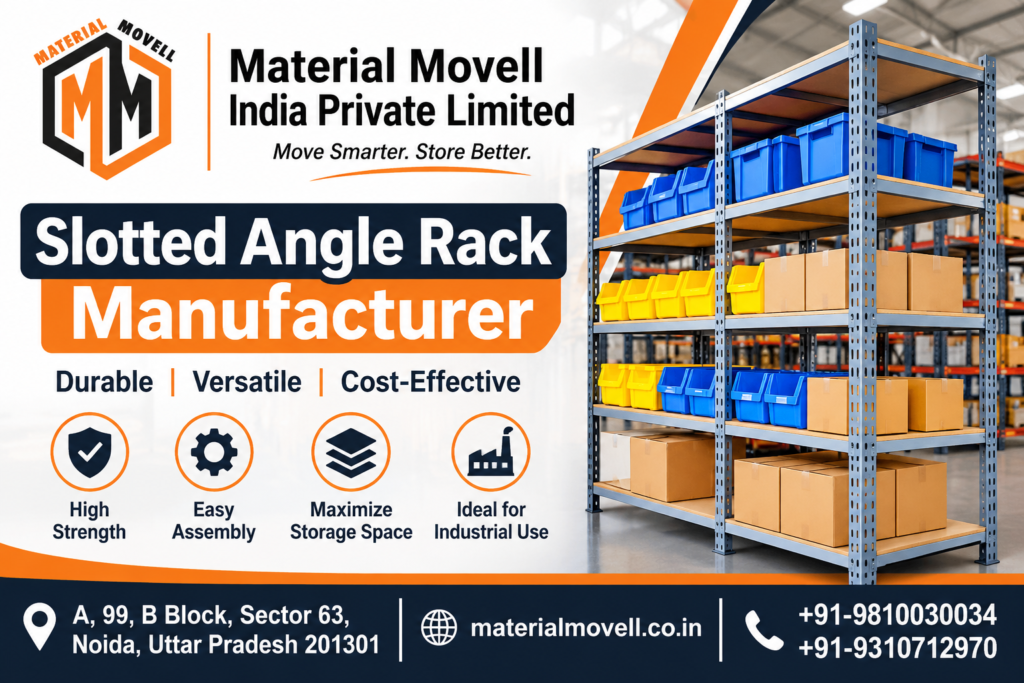
Slotted Angle Rack Manufacturer

Slotted Angle Rack Manufacturer Types, Advantages & Buying

Every warehouse, factory and workshop runs into the same problem sooner or later: inventory grows, but floor space does not. Loose cartons on the floor slow down picking, damage stock and make it harder to keep the area safe. Industrial slotted angle racks are one of the most practical ways to fix this. They are widely used because they are simple, adjustable and easy to adapt as storage needs change. This guide explains what slotted angle racks are, the main types, their advantages, where they are used, and what to check before you buy from a Slotted Angle Rack Manufacturer. Quick Answer: What Are Industrial Slotted Angle Racks? Slotted Angle Rack Manufacturer are metal storage systems built from pre-slotted steel angles that are bolted together to form frames and shelves. Their adjustable design lets businesses change shelf heights and layouts easily. They are used in warehouses, factories, workshops, retail stores and offices to store goods, tools and spare parts. What Are Industrial Slotted Angle Racks? A slotted angle rack is assembled from steel angle sections with evenly spaced slots along their length. Because the slots run along the angle, the same section can be used as an upright, a cross brace or a shelf support. This is what gives the system its flexibility. Main components How it works: The parts are fixed with bolts through the slots. To change a shelf height or add a level, you loosen the bolts, reposition the shelf and tighten them again. No specialised machinery is needed for this, which is why the system suits businesses whose inventory changes often. Racks are generally made from steel and finished with a protective coating such as paint or powder coating. The right material thickness and finish depend on the load and the environment, so confirm these with your supplier. What Are the Different Types of Slotted Angle Racks? Slotted angle racks are usually grouped by the load they are designed for and by how they are configured. The table below gives a general overview. Exact capacities depend on the design and must be confirmed with the manufacturer. Type Typical Use Key Feature Light duty Files, small parcels, retail stock Compact and economical Medium duty Cartons, tools, workshop items Balance of strength and cost Heavy duty Bulky or heavier goods, machine parts Stronger sections and bracing Adjustable Changing inventory sizes Shelf heights can be reset Multi-tier Space-limited areas Several levels in one footprint Customised Unusual sizes or loads Built to a specific requirement Light Duty Slotted Angle Racks These suit lighter items such as documents, small packages and retail goods. They are common in offices, shops and small stores where loads are modest and budgets are tight. Medium Duty Slotted Angle Racks Medium duty racks handle a wider range of everyday storage, including boxed goods, hand tools and workshop supplies. They are a common choice when light duty racks are not enough but heavy duty is unnecessary. Heavy Duty Slotted Angle Racks A heavy duty slotted angle rack uses stronger sections and better bracing for bulkier or heavier goods. Always share the actual weight per shelf with your supplier rather than assuming a rack is “heavy duty” by name. Adjustable Slotted Angle Racks Adjustable racks are the core strength of this system. Shelf levels can be moved to suit different item sizes, so one rack can serve different purposes over time. Multi-Tier Slotted Angle Racks Multi-tier racks use vertical space by stacking several shelf levels. They help when floor area is limited but ceiling height is available. Customised Slotted Angle Storage Racks Some spaces have unusual dimensions, low ceilings or specific item sizes. A manufacturer can design a rack to those measurements instead of forcing the space to fit a standard size. What Are the Major Advantages of Slotted Angle Racks? One practical point: a bolted design can be expanded later. A business that starts with a few racks can add bays as it grows, which makes planning easier for small and growing operations. Where Are Slotted Angle Racks Used? Slotted angle racks appear in many sectors: For example, a maintenance store in a factory might use adjustable racks to separate bearings, belts and fasteners, with taller items on lower shelves and small parts at eye level. How Do You Choose the Right Slotted Angle Rack? (Buying Considerations) Before requesting a quotation, work through these points. Quick comparison: standard vs customised racks Factor Standard Racks Customised Racks Lead time Usually shorter Depends on the design Fit for unusual spaces Limited Better Cost Generally lower Depends on the requirement Best for Common storage needs Specific dimensions or loads A safety note: do not exceed the rated load, and distribute weight evenly, with heavier items on lower shelves. Racks that are overloaded or poorly assembled can become unsafe. Why Choose the Right Slotted Angle Rack Manufacturer? A rack is a long-term asset, so the manufacturer matters as much as the product. A dependable slotted angle rack manufacturer helps in several ways: Material Movell India Private Limited is a manufacturer and supplier of industrial material handling and storage solutions. Businesses looking for a slotted angle rack supplier can discuss their storage requirements with the team, share their dimensions and loads, and explore suitable options. As with any purchase, request written specifications so you can compare offers on equal terms. Frequently Asked Questions (FAQs) What is a slotted angle rack used for? It is used to store goods, tools, files and spare parts in warehouses, factories, workshops, shops and offices. Its adjustable shelves allow different item sizes to be stored on the same rack. What is the difference between light duty and heavy duty slotted angle racks? The difference lies in the sections, bracing and the load each shelf is designed to carry. Light duty racks suit small, light items, while heavy duty racks are built for bulkier, heavier goods. Are slotted angle racks adjustable? Yes. Shelf positions can be changed by loosening the bolts and refitting the shelf at a

Slotted Angle Rack Manufacturer Types, Advantages & Buying Read More »
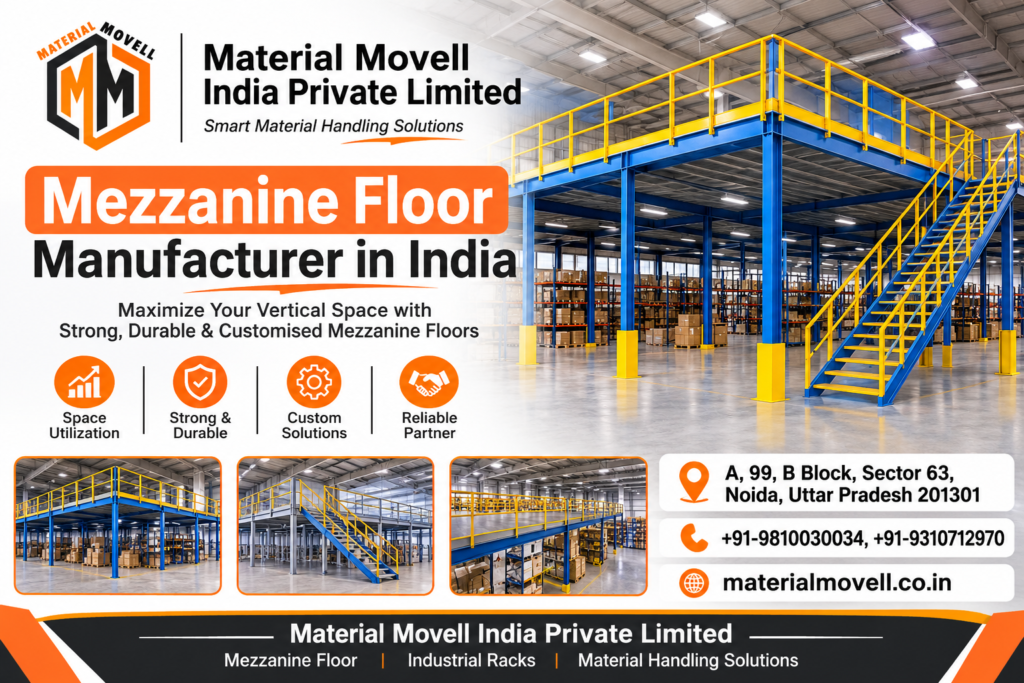
Mezzanine Floor Manufacturer in India

Mezzanine Floor Manufacturer in India: Types, Benefits & Industrial Applications

Warehouses fill up faster than they were planned to. Inventory grows, product lines multiply, and the floor area that looked generous five years ago now feels tight. Moving to a bigger facility is costly, and extending the building takes time and disrupts operations. A smarter option is to build upward inside the space you already have. That is exactly what a mezzanine floor does. If you are searching for a reliable Mezzanine Floor Manufacturer in India, this guide explains how mezzanine systems work, the main types, their benefits, where industries use them and what to check before you buy. Material Movell India Private Limited, based in Noida, manufactures and supplies industrial storage solutions, including customized steel mezzanine floors for warehouses, factories and commercial facilities. What Is a Mezzanine Floor? A mezzanine floor is an intermediate platform built between the floor and ceiling of an industrial building. Supported by a steel structure, it adds a usable level for storage, production or offices without expanding the building footprint. Industries use it to turn unused vertical space into productive floor area. How Does a Mezzanine Floor Work? Many warehouses and factories have high ceilings, but most of that height sits empty a above racks, machines and work areas. A mezzanine floor creates a second working level in that empty volume. Goods, people, equipment or workstations can then use both the ground level and the new platform. Main structural components Mezzanine floor vs. conventional building extension A conventional extension needs new foundations, civil work and often statutory approvals, and it can take months. A mezzanine floor is a steel structure built inside the existing building. It is generally faster to install, is modular, and can be expanded or modified as needs change. Even so, it is a structural system, so design, installation and use must comply with applicable building codes, fire safety requirements and local regulations. What Are the Types of Mezzanine Floors? Mezzanine systems differ mainly in how they are supported and what they carry. The right choice depends on your layout, loads and how the space will be used. 1. Structural steel mezzanine floors Built from steel columns and beams designed for the loads of the project. They suit heavy storage, production areas and offices inside factories. 2. Freestanding mezzanine floors They stand on their own columns and do not depend on racks or the building walls. This makes them flexible to relocate or reconfigure. 3. Rack-supported mezzanine floors The platform sits on a racking structure, so storage below and above work as one integrated system. They suit high-density pallet or carton storage. 4. Shelving-supported mezzanine floors Here, shelving units carry the floor above. They are common for spare parts, small items and picking operations. 5. Multi-tier mezzanine floors Two or more platforms are stacked where ceiling height allows. They multiply the usable area in tall buildings. 6. Industrial warehouse mezzanine floors Heavy-duty platforms designed for pallets, material handling equipment and continuous operations in warehouses and distribution centres. Mezzanine floor types compared Type Best suited for Key advantage Structural steel Heavy storage, production, offices Strength designed around project loads Freestanding Flexible layouts, changing needs Independent of racks and walls Rack-supported High-density storage Storage and platform work as one system Shelving-supported Spare parts, small-item picking Efficient use of shelving as support Multi-tier Tall buildings, space-constrained sites Several working levels in one footprint Industrial warehouse Pallets and heavy handling Built for continuous warehouse use Not every manufacturer builds every type. Ask Material Movell’s team which configuration suits your project before finalising the design. What Are the Benefits of Installing a Mezzanine Floor? Where Are Mezzanine Floors Used? For example, a spare parts store can place fast-moving items on the ground level and slow movers on the mezzanine, with a lift or conveyor linking the two. A factory can keep its inspection and packing area on the platform, leaving the ground floor free for machines. What Should You Check Before Choosing a Mezzanine Floor Manufacturer in India? Structural design and installation should follow applicable building codes, fire safety requirements and local regulations. Verify these requirements with your engineer and local authorities. Why Choose Material Movell India Private Limited? Material Movell is a Noida-based manufacturer and supplier of industrial storage solutions, modular structures and material handling products. For mezzanine floors, the company highlights: Because storage is the company’s core field, mezzanine floors can be planned alongside heavy duty racks, FIFO racks or slotted angle racks, so the whole storage layout works together. How to Select the Right Mezzanine Floor System Frequently Asked Questions 1. What is a mezzanine floor?  A mezzanine floor is an intermediate platform installed between a building’s floor and ceiling. It creates extra space for storage, production or offices without enlarging the building. 2. Who is a good mezzanine floor manufacturer in India for warehouses?  Look for a manufacturer that designs to your loads, uses quality structural steel, offers customization and supports installation. Material Movell India Private Limited, based in Noida, offers customized steel mezzanine floors for warehouses and industrial facilities. 3. What materials are used for a steel mezzanine floor?  Structural steel sections form the columns and beams, usually with a corrosion-resistant finish. The deck material depends on how the platform will be used. 4. How much weight can a mezzanine floor hold?  There is no single figure. Capacity depends on the design, spans, materials and intended use, and must be confirmed through engineering calculations for your project. 5. How much does a mezzanine floor cost?  Price depends on area, load requirements, height, flooring, staircases, safety fittings and site conditions. A manufacturer can give an accurate quotation once it has your requirements. 6. Can a mezzanine floor be customized?  Yes. Size, layout, load capacity, flooring and access can be tailored. Material Movell provides customized mezzanine solutions based on space, load and operational needs. 7. Can a mezzanine floor be expanded later?  Modular, bolted construction generally allows extra bays or modifications later, subject to engineering review of the existing structure. Conclusion A

Mezzanine Floor Manufacturer in India: Types, Benefits & Industrial Applications Read More »

Castor Wheel Manufacturer in India

Castor Wheel Manufacturer in India: Types, Benefits & Industrial Applications

Every trolley, rack, cart and piece of mobile equipment in a factory depends on a small component that rarely gets attention until it fails: the castor wheel. A wheel that is too soft, too small or wrongly rated can make a trolley hard to push, damage floors, increase noise and shorten equipment life. This guide is for procurement teams, warehouse managers and equipment builders who are comparing a Castor Wheel Manufacturer in India. It explains what castors are, how the main types differ, how to estimate load capacity, and what to ask a supplier before you order. What Is a Castor Wheel and How Does It Work? A castor wheel is a wheel mounted in a bracket (also called a fork or frame) so that a load can be moved on it. The assembly is then fixed to the base of a trolley, rack, machine or platform. A typical castor has four parts: In a fixed castor, the wheel can only roll forward and backward. In a swivel castor, the wheel also turns to follow the direction of push. Types of Industrial Castor Wheels Buyers often mix up three separate decisions: wheel material, bracket construction and mounting configuration. You choose each one independently, so a PU wheel, for example, can be fitted to different bracket types and used in fixed or swivel form. By load duty and construction By wheel material By mounting configuration A common trolley layout uses two fixed and two swivel castors. Others use four swivels for tight manoeuvring. Key Benefits of Choosing the Right Castor Wheels The right castor does not just roll; it affects how the whole workplace runs. Possible benefits include: Actual performance depends on the specific product, the load and the working conditions. A wheel that performs well on a smooth warehouse floor may not suit a rough foundry yard. Industrial Applications of Castor Wheels Different workplaces place different demands on a wheel, which is why one specification rarely fits every site. How to Choose the Right Castor Wheel for Your Application Use this checklist before requesting a quote. Load-capacity calculation example Suppose a trolley weighs 200 kg empty and carries up to 800 kg of material. It has four castors. In real use, floors are not perfectly flat and loads shift, so you should not size on the even share alone. A common approach is to assume only three wheels carry the load at any moment: Then add a margin for shocks and starting or stopping forces. If you add 25% as an illustrative margin, you get roughly 417 kg per wheel. This is an example, not a standard. The margin you need depends on speed, floor condition and handling practice. Always compare your figure with the manufacturer’s rated capacity for the exact wheel and castor, and confirm the rating applies to your configuration. For complex or high-risk applications, consult the manufacturer’s technical team. PU vs Rubber vs Nylon Castor Wheels Which castor wheel material suits which floor? This table gives a starting point. Wheel Material Key Characteristics Suitable Applications Important Considerations Polyurethane (PU) Often combines wear resistance with floor protection Industrial trolleys and material handling Grade, hardness, load, and floor conditions Rubber Often provides cushioning and quieter movement Carts and equipment requiring shock absorption Rolling resistance, load, and temperature Nylon Often offers low rolling resistance and wear resistance Suitable industrial and commercial applications Noise, floor hardness, and impact conditions Actual performance varies with material formulation, wheel design and manufacturer specifications. Treat the table as a guide and confirm details on the product datasheet. Why Choose Material Movell India Private Limited for Castor Wheels? Material Movell India Private Limited describes itself on its website as a manufacturer and supplier of heavy-duty castors, castor wheels, trolley wheels and industrial wheels. The website says the company was founded by Mr. Ashok Khandelwal in 1975 and set up its Noida Sector-63 company in 1999, and that it operates additional units in Roorkee and Greater Noida. Its Castors & Wheels category lists 35 products. Examples shown on the site include: Beyond wheels, the company also lists industrial racks, pipes, metal joints, aluminium profile and related items, which can be useful if you are building complete trolleys or workstations. For sizes, load ratings and configurations, refer to each product page and the downloadable catalogue on the website rather than relying on a general guide. If your application is unusual, contact the team for guidance. Frequently Asked Questions About Castor Wheels 1. Which castor wheel material is best for different floors? Softer treads such as PU or rubber generally suit finished floors where noise and floor protection matter. Harder wheels like nylon or cast iron roll easily on smooth, hard surfaces under heavy loads. Rough or damaged floors usually call for larger wheels. Confirm the choice against your actual floor and load. 2. How do I calculate the load capacity of castor wheels? Add the equipment’s own weight and its maximum payload, then divide by the number of wheels. Because loads shift and floors are uneven, many buyers assume fewer wheels share the load and add a margin for shocks. Always check the manufacturer’s rated capacity for your exact castor. 3. When should I use fixed castors and when should I use swivel castors? Use fixed castors where the equipment needs to travel in a straight line, such as long aisle runs. Use swivel castors where turning, positioning and tight spaces matter. Many trolleys combine two fixed and two swivel castors to balance steering and tracking. Four swivels give maximum manoeuvrability. 4. Are PU castor wheels better than rubber castor wheels? Neither is better in every case. PU is often chosen for industrial trolleys where wear resistance and floor protection are priorities. Rubber is often chosen for cushioning and quieter rolling. The better choice depends on load, floor, temperature and the grade of material, so check specifications. 5. Does wheel diameter really matter? Yes. A larger diameter generally rolls more easily over joints, debris and uneven floors,

Castor Wheel Manufacturer in India: Types, Benefits & Industrial Applications Read More »

Assembly Tables Manufacturer

Assembly Tables Manufacturer: A Complete Guide to Types, Features

Every production floor has a point where parts, tools and people meet. That point is the assembly table. Whether operators are fitting components, inspecting finished goods or packing orders, the table decides how comfortably and consistently the work gets done. Choosing the right Assembly Tables Manufacturer is therefore more than a purchasing task. The table you select affects workstation suitability, operator ergonomics, workflow organisation and day-to-day efficiency. This guide explains what industrial assembly tables are, the main types available, the features worth checking and how to evaluate a supplier before you place an order. Quick Answer: What Is an Industrial Assembly Table? An industrial assembly table is a sturdy workstation where operators assemble, inspect, pack or handle components. It combines a load-bearing frame, a durable worktop and, often, accessories such as shelves, tool holders and lighting. Factories, electronics units, automotive workshops and packaging lines use it to organise work and support consistent, ergonomic production. What Are the Key Features of Industrial Assembly Tables? Features vary by model and manufacturer, so treat the list below as a checklist to confirm against written specifications. Types of Industrial Assembly Tables Fixed-Height Assembly Tables These have a set working height and a simple, robust build. They suit stable processes where the same operators perform the same task for long periods. Height-Adjustable Assembly Tables Adjustability, whether by manual crank, pin settings or powered lift where offered, helps when operator heights vary or when one station handles several tasks. Heavy-Duty Industrial Work Tables Built with stronger frames and thicker tops, these handle heavy components, fixtures and impact-prone work such as fitting and fabrication. Modular Assembly Workstations Modular systems are built from profiles or pipes and joints, so the layout can be reconfigured without welding. They suit lean manufacturing, where stations change as processes improve. ESD-Safe Assembly Tables These use static-dissipative worktops and grounding provisions to protect sensitive electronic components during handling and assembly. Assembly Tables With Storage and Tool-Management Accessories Drawers, shelves, bins, tool rails and monitor arms keep the station tidy and put what the operator needs within reach. Production-Line and Specialised Assembly Workstations These are designed around a particular product or line, often with fixtures, conveyors, lighting or pneumatic connections built in. Comparison of Assembly Table Types Table type Key benefit Typical application Fixed-height assembly table Simple, stable and economical Repetitive assembly with the same operators Height-adjustable assembly table Suits different operators and tasks Mixed-task stations, inspection, light assembly Heavy-duty industrial work table High load handling and rigidity Engineering workshops, fabrication, heavy components Modular assembly workstation Easy to reconfigure and expand Lean production lines, changing layouts ESD-safe assembly table Protects sensitive electronics Electronics and electrical assembly Table with storage and tool accessories Better organisation near the operator Tool-intensive assembly, kitting, maintenance Production-line workstation Built around a specific process Dedicated assembly lines, packaging, inspection Not every manufacturer offers every type. Confirm the exact range, specifications and customisation options with the supplier you are considering. Benefits of Using the Right Assembly Table A well-chosen table cannot fix a poor process, but it supports a good one. Realistic benefits include: The size of these gains depends on your process, layout and training, so measure results at your own station rather than relying on generic claims. Industrial Applications of Assembly Tables Requirements change with the task, the equipment, the material and the environment. A station for fine electronic work and one for fitting engine parts may both be called assembly tables, yet their specifications will differ considerably. How to Choose the Right Assembly Tables Manufacturer Use this checklist when you shortlist suppliers: Compare documented specifications rather than choosing on price alone. A cheaper table that bends under load or cannot be extended costs more once downtime, replacement and rework are counted. Assembly Tables vs. Standard Workbenches The two categories overlap, and the right choice depends on the workstation requirement. Aspect Assembly table Standard workbench Typical purpose Repeatable assembly, inspection and packing General repair, maintenance and fabrication Configuration options Often modular, with ergonomic and line-oriented features Usually fixed, with a heavier general-purpose build Accessory compatibility Commonly designed for shelves, lighting and tool holders Varies; often drawers or a vice Best suited to Production lines and organised workstations Workshops and maintenance areas Some heavy-duty assembly tables behave like workbenches, and some workbenches can be fitted out as assembly stations. Define the task first, then choose the format. Why Consider Material Movell India Private Limited? Material Movell India Private Limited is based in Noida, Uttar Pradesh. According to its website, the company was established in 1999 in Sector 63, Noida, and now operates manufacturing units in Noida, Roorkee and Greater Noida, with another unit under construction in Jewar. It is best known for castors and trolley wheels, and its range also includes industrial racks, pipes, metal joints and aluminium profile products. For workstation requirements, the site lists an Aluminium Profile Table. The product page describes it as a modular workstation built from anodised aluminium T-slot profiles. It can be fitted with accessories such as shelves, drawers, tool holders, monitor mounts, lighting, power sockets and cable organisers, and it is described as suitable for assembly lines, inspection stations, packaging, electronics, automotive and laboratory use. The company’s lean pipe and parts and pipes range is also described on its homepage as used in modular workstations and production lines. For mobile stations, its castors and wheels can be considered alongside the frame. If you need a different table format, such as an ESD-safe or height-adjustable configuration, send your drawing, load and size requirements through the contact page and ask what can be supplied. Confirm specifications, warranty and delivery terms in writing before ordering. Frequently Asked Questions 1. What does an Assembly Tables Manufacturer do?  An Assembly Tables Manufacturer designs and produces workstations for assembling, inspecting, packing and handling components. Many also supply accessories and customised configurations. 2. How do I choose the right industrial assembly table?  Start with the task, the largest item, the load and the available space. Then check worktop material,

Assembly Tables Manufacturer: A Complete Guide to Types, Features Read More »

Heavy Duty Rack Manufacturer in Noida

Heavy Duty Rack Manufacturer in Noida: Complete Guide to Industrial Storage Solutions

Every warehouse, factory and distribution centre eventually runs short of floor space. Goods pile up in aisles, picking slows down, and safety suffers. Well-planned heavy-duty racks fix this by moving storage upwards, keeping inventory organised and making material handling smoother. If you are searching for a Heavy Duty Rack Manufacturer in Noida, this guide explains the rack types available, where each is used, how to evaluate a supplier and what shapes the final quotation. Quick Answer A heavy duty rack manufacturer designs and fabricates steel racking that safely stores heavy, bulky or palletised goods. When choosing one in Noida, check load capacity, material quality, layout fit, forklift compatibility, installation support and customisation options before you compare prices. What Is a Heavy-Duty Storage Rack? A heavy-duty storage rack is a structural steel system built to hold loads that ordinary shelving cannot carry. Typical parts include upright frames, horizontal beams or supports, bracing and shelf decking. Each part is sized for the weight it must carry. The right design depends on four things: Two warehouses of the same size can need very different racks. A spare-parts store picking small cartons by hand has little in common with a plant storing palletised raw material for forklifts. Types of Heavy-Duty Industrial Racks Buyers meet several racking styles when they shop for industrial racking systems. The table compares the common ones in general terms. Rack type Best suited for Practical advantage Main limitation Heavy-duty pallet rack Palletised and bulky goods High load capacity per level Needs forklift aisles Selective pallet racking Mixed stock with many SKUs Direct access to every pallet Lower storage density Drive-in racking Large volumes of the same item High density, fewer aisles Last-in, first-out access Multi-tier racking / mezzanine Sites with height but limited floor area Adds working or storage levels Needs structural planning Slotted angle or FIFO rack Components, cartons, spare parts Flexible adjustment, ordered stock rotation Lower capacity than pallet racks These are general categories, not a product list. Material Movell’s website currently lists Heavy Duty Rack, Slotted Angle Rack, FIFO Rack and Mezzanine Floor under its industrial racks category. For pallet, drive-in or other configurations, ask the team directly whether they can supply them. Benefits of Heavy-Duty Racks for Warehouses and Factories A properly specified racking system can support daily operations in several ways: Safety benefits too. Goods stored on rated racks are less likely to be stacked unsafely on the floor. How to Choose a Heavy Duty Rack Manufacturer in Noida Noida and the wider NCR region have many fabricators. A structured checklist makes comparison fairer. 1. Load capacity and configuration Share the weight of the heaviest pallet or item, the number of levels and the bay width. A good supplier will ask for these details before quoting. 2. Material quality and specification Ask for the steel grade, thickness and finish in writing. Powder coating or similar protective finishes matter in humid or dusty settings. 3. Space, layout and handling equipment Check ceiling height, column positions and aisle width. Confirm the rack suits your forklift or pallet truck turning radius. 4. Installation, inspection and maintenance Find out who installs the racks and who inspects them afterwards. Beams, uprights and base plates should be checked regularly for damage or loosening. 5. Customisation and after-sales support Industrial plants rarely fit standard dimensions. Ask whether custom industrial storage racks are possible and who handles later changes. 6. Documentation and safety practice Request drawings, load charts and installation guidance. Clear load-capacity labelling for each bay is a basic safety practice. Tip: visit the supplier’s work or request a site discussion before placing a bulk order. Applications of Heavy-Duty Storage Racks Heavy-duty racks for factories and warehouses are used wherever weight, volume or variety makes floor storage impractical: Practical example: a component maker may keep bulky castings on heavy-duty racks near the line, and small fasteners on slotted angle racks near the packing area. The rack type follows the item, not the other way round. Why Consider Material Movell India Private Limited? Material Movell India Private Limited is a Noida-based industrial manufacturer. Its website describes a company founded in 1975 by Mr. Ashok Khandelwal, with a Noida Sector 63 company established in 1999. It is best known for castors, caster wheels and trolley wheels, and it also offers industrial racks. Here is what the website states that is relevant to storage buyers: For storage buyers in Noida, that combination of a local presence and an industrial rack range makes the company worth shortlisting. Share your load, space and handling details, and ask the team to confirm what it can supply for your project. Factors Affecting Heavy-Duty Rack Selection and Cost No honest supplier can quote a rack without specifications. These factors move the final price: Factor Why it affects the quotation Dimensions Larger bays and taller racks use more steel Load specification Higher capacity needs heavier sections and bracing Material and thickness Steel grade and gauge change strength and weight Finish Powder coating or other coatings add protection and cost Storage configuration Levels, bay count and accessories alter the design Installation Site access, height and working conditions matter Order quantity Bulk orders may be priced differently Prices are not stated here because they depend on your exact requirement. Browse the Industrial Racks category to see the range, view the Heavy Duty Rack and Slotted Angle Rack pages, or use the contact page to request a quote. Frequently Asked Questions What does a heavy duty rack manufacturer in Noida do? It designs, fabricates and supplies steel racking for heavy or bulky goods, usually to suit the buyer’s load, space and handling equipment. Which heavy-duty rack is best for a warehouse? It depends on stock and equipment. Pallet racks suit forklift-handled goods, while slotted angle or FIFO racks suit lighter components and cartons. How do I know the right load capacity? Weigh your heaviest loaded pallet or item, then ask the manufacturer to size the beams and uprights with a suitable safety margin.

Heavy Duty Rack Manufacturer in Noida: Complete Guide to Industrial Storage Solutions Read More »

Heavy Duty Castor Wheels Manufacturer

Heavy Duty Castor Wheels Manufacturer | Types & Applications

Quick Answer: Heavy duty castor wheels are load-rated wheel assemblies mounted with a swivel or fixed fork, used to move heavy machinery, trolleys, and industrial equipment across warehouse and factory floors. When selecting one, buyers should evaluate load capacity per wheel, wheel material, floor surface, swivel vs. fixed configuration, and braking needs before finalising a supplier. Moving heavy loads safely across a factory floor or warehouse aisle depends on one small but critical component: the castor wheel. A heavy duty castor wheel is engineered to carry substantially higher loads than a standard-duty castor, without compromising rolling ease, floor safety, or long-term stability. Choosing the wrong castor — whether undersized, made from the wrong material, or unsuited to the floor surface — can lead to premature wheel failure, difficulty in manoeuvring, and even safety risks for operators. This guide covers what heavy duty castor wheels are, the common types available, their key components, typical applications, and a practical framework for selecting the right castor for your equipment. It’s written for procurement teams, plant engineers, and warehouse managers evaluating a Heavy Duty Castor Wheels Manufacturer for trolleys, racks, workstations, and material handling equipment. What Are Heavy Duty Castor Wheels? A castor wheel is a wheel-and-bracket assembly that attaches to the underside of equipment to allow it to be rolled from one location to another. A heavy duty castor is built to carry significantly greater loads — typically starting from a few hundred kilograms per wheel and going up to a few tonnes, depending on design — compared to light or medium-duty castors used on furniture or small carts. Main components of a heavy duty castor include the wheel (tread and core), the bearing, the fork or yoke that holds the wheel, and the mounting arrangement (plate or stem) that attaches it to the equipment. Load-bearing function: The wheel tread and core absorb and distribute the weight of the load as it rolls, while the fork and bearing manage the rotational movement (swivel) and keep the assembly stable under load. Heavier-duty designs typically use thicker fork walls, larger diameter wheels, and higher-grade bearings to handle sustained industrial use. Standard vs. heavy duty castors: Standard castors are designed for lighter, intermittent use — think office chairs or retail display units. Heavy duty castors are built for continuous industrial movement of substantial loads, often on rougher floor surfaces, and are constructed with reinforced forks, larger wheel diameters, and industrial-grade wheel materials such as polyurethane, cast iron, or forged steel. Industries use heavy duty castors wherever equipment, racks, or trolleys need to be repositioned without lifting — reducing manual handling effort and improving workflow efficiency across warehouses, manufacturing units, and logistics operations. Types of Heavy Duty Castor Wheels Swivel Heavy Duty Castors Swivel castors rotate 360 degrees around a vertical axis, allowing equipment to be turned and manoeuvred in tight spaces. They’re commonly used on trolleys and carts that need directional flexibility, especially in aisles and workstations where frequent turning is required. Fixed Heavy Duty Castors Fixed castors roll only in a straight line and don’t swivel. They’re typically paired with swivel castors on the same trolley (two fixed, two swivel) to provide directional stability during straight-line movement of heavy loads, particularly over longer distances. Heavy Duty Plate Castors These castors attach via a flat mounting plate bolted to the underside of equipment. Plate mounting distributes load over a wider area and is common on industrial trolleys, workstations, and equipment stands where a stable, bolt-on fixing is preferred. Polyurethane Heavy Duty Castors Polyurethane (PU) wheels combine a hard core with a resilient PU tread, offering a good balance of load capacity, floor protection, and smooth rolling resistance. They’re widely used indoors on concrete, epoxy, or tiled floors where floor marking needs to be minimised. Cast Iron Heavy Duty Castors Cast iron wheels are solid, rigid, and capable of carrying very high loads, making them suitable for extremely heavy equipment. They perform well on smooth, hard floors but can be noisier and may mark softer flooring surfaces compared to polyurethane options. Rubber Heavy Duty Castors Rubber wheels offer good shock absorption and quieter operation, useful where floor protection and noise reduction matter. They tend to have somewhat lower load ratings than PU or cast iron equivalents of the same size, so load requirements should be checked carefully. Stainless Steel Heavy Duty Castors Stainless steel castors (frame and fork construction) are used where corrosion resistance is important — such as washdown areas, food processing zones, or humid environments — since standard steel components can rust under repeated moisture exposure. Heavy Duty Castor Wheels: Key Components Component Function Wheel material Determines load capacity, floor grip, noise level, and floor protection Wheel diameter Larger diameters generally roll easier and handle uneven floors better Load capacity The rated maximum weight the wheel can safely carry Bearing Reduces rolling resistance; ball or roller bearings suit heavier, frequent use Fork/frame Holds the wheel and transfers load from the equipment to the wheel Mounting plate/stem Fixes the castor to the equipment — plate or threaded stem, depending on design Swivel mechanism Allows directional rotation; quality affects manoeuvrability under load Brake system Locks the wheel to prevent movement during loading, unloading, or static use Applications of Heavy Duty Castor Wheels Heavy duty castor wheels are used across a wide range of industrial settings, including: How to Choose the Right Heavy Duty Castor Wheels Selecting the right castor involves more than checking a load rating on a spec sheet. Consider the following factors: Estimating load capacity per wheel: A simple starting formula is: Required capacity per wheel = (Total load + equipment weight) ÷ Number of wheels × Safety factor For example, a 4-wheel trolley carrying a combined load of 800 kg would need each wheel rated for at least 200 kg before applying a safety margin. In practice, load distribution is rarely perfect even — corners, uneven floors, and dynamic movement (starting, stopping, turning) can shift more weight onto individual wheels. Most suppliers recommend

Heavy Duty Castor Wheels Manufacturer | Types & Applications Read More »

Industrial Castor Wheels Manufacturer

Industrial Castor Wheels Manufacturer | Heavy Duty Wheels

If a wheel fails under load, the cost is never just the wheel. It’s a stalled production line, a damaged floor, a spilled load, or an injured worker. That’s why choosing the right Industrial Castor Wheels Manufacturer matters more than most procurement teams realize — the wheel is a small component with an outsized impact on plant safety and uptime. At Material Movell, we’ve been manufacturing heavy duty industrial castor wheels and trolley wheels in India since 1975, and we’ve seen firsthand how the right castor selection prevents downtime, reduces maintenance costs, and keeps material handling operations running smoothly. This guide walks through everything a factory owner, procurement manager, or maintenance engineer needs to know before buying industrial caster wheels — from load calculations to material selection to common failure points. What Are Industrial Castor Wheels? Industrial castor wheels are wheel-and-bracket assemblies designed to be mounted under trolleys, carts, workstations, machinery, and equipment so they can be moved with minimal effort. Unlike standard furniture or light-duty casters, industrial trolley wheels are built to carry significant weight repeatedly, across long shifts, often on rough or uneven factory floors, without breaking down. A castor assembly typically consists of: Every one of these components affects how the castor performs under load, and a weak link anywhere in this chain leads to premature failure. Why the Right Manufacturer Matters More Than the Lowest Price Many procurement teams shop industrial castor wheels purely on unit price. This is where most costly mistakes happen. A castor priced 15% lower but rated for a lower load capacity, made with inferior bearing steel, or using low-grade polyurethane, will typically fail within months in continuous-use environments — leading to replacement costs, unplanned downtime, and in worse cases, safety incidents. A genuine industrial wheels manufacturer should be able to answer these questions confidently: At Material Movell, our castors are manufactured in-house across our Noida, Roorkee, and Greater Noida facilities — including an automatic CED (Cathodic Electro Deposition) coating plant for enhanced corrosion resistance on metal components. This vertical integration lets us control quality at every stage, from raw sheet metal and forging to final assembly, rather than outsourcing critical components to third parties. Types of Heavy Duty Castor Wheels Not aoor surface, speed of movement, and environmental conditions. 1. Fixed vs. Swivel Castors 2. Wheel Material Types Wheel Type Best For Key Property Cast Iron / Steel Extremely heavy static or slow-moving loads Maximum load capacity, low rolling resistance Polyurethane (PU) General industrial and warehouse use High load capacity, floor-friendly, quiet Elastomer / Rubber Uneven floors, shock absorption Cushioned ride, noise reduction Nylon Chemical or moisture-heavy environments Corrosion resistant, durable in harsh conditions Cast Polyurethane on Aluminium Core (ALCPU) High-load trolleys needing durability with lighter weight Combines strength of metal core with cushioning of PU tread 3. Spring-Loaded / Shock-Absorbing Castors For applications where loads travel over uneven flooring, expansion joints, or dock plates, heavy load castor wheels with a spring-loaded or forged shocker mechanism absorb impact and protect both the load and the floor from repeated shock stress. How to Choose the Right Industrial Castor Wheels Selecting castors for industrial equipment correctly the first time avoids costly replacements later. Use this framework: Step 1: Calculate the Actual Load Add the weight of the equipment/trolley itself to the maximum expected load, then divide by the number of castors — but never assume equal weight distribution. As a safety margin, select castors rated for at least 25–30% above your calculated per-wheel load, since uneven weight distribution and dynamic movement (starting, stopping, turning) increase actual stress on individual wheels. Step 2: Assess the Floor Surface Step 3: Consider the Operating Environment Temperature extremes, chemical exposure, and moisture all degrade certain materials faster. Industrial material handling wheels used in cold storage, for example, need wheel compounds rated for low-temperature flexibility, while wheels in chemical plants need corrosion-resistant brackets and non-reactive tread materials. Step 4: Match Wheel Diameter to Movement Ease Larger diameter wheels roll more easily over floor irregularities and require less pushing force — a critical factor for manual trolleys handled by workers across long shifts. Smaller wheels suit tighter spaces but increase rolling resistance. Step 5: Decide on Braking Requirements Any application involving loading/unloading, height-adjustable workstations, or use near ramps and inclines should include braked castors to prevent unintended movement. Common Applications of Heavy Duty Wheels Heavy duty wheels and industrial castors are used across nearly every sector that moves physical goods: Because usage patterns differ so widely, industrial castor wheels for material handling should always be specified for the actual application rather than picked from a generic catalog listing. Signs Your Industrial Castors Need Replacement Waiting until a wheel fails completely often causes secondary damage. Watch for: Proactive replacement based on these signs is far cheaper than the downtime and potential safety risk of an in-service failure. Why Choose Material Movell as Your Industrial Castor Wheels Manufacturer Material Movell India Pvt. Ltd. was founded on the principle of producing wheels and castors that exceed expectations on both quality and performance. Over five decades, that has translated into: Whether you need a single trolley wheel replacement or a bulk order for a new production line, our team works directly with procurement managers and engineers to match the right castor to the right application. Frequently Asked Questions What is the difference between a castor wheel and a regular wheel?  A castor wheel includes the wheel plus a mounting mechanism (fork, plate, or stem) that allows it to swivel or roll in a fixed direction. A regular wheel is just the rolling component and requires a separate axle mounting. What load capacity do heavy duty industrial castor wheels typically carry?  Depending on wheel material, diameter, and bearing type, heavy duty industrial castors can range from around 200 kg to over 5,000 kg per wheel. Always confirm the manufacturer’s rated capacity for your specific model rather than assuming based on wheel size alone. Which wheel material is best for heavy loads on concrete

Industrial Castor Wheels Manufacturer | Heavy Duty Wheels Read More »

Tesing Blog Page

Premium Medium Duty Fixed Castor (Pressed Steel) with Polypropylene Wheel for Industrial Material Handling Material Movell (India) Pvt. Ltd. offers premium-quality Medium Duty Fixed Castor (Pressed Steel) with Polypropylene Wheel designed to provide reliable straight-line movement, superior load-bearing capacity, and long-lasting durability for medium-duty industrial and commercial applications. Manufactured using premium pressed steel brackets and high-strength polypropylene wheels, these fixed castors ensure smooth transportation, excellent stability, and dependable performance in warehouses, manufacturing units, retail facilities, hospitals, and logistics centers. Unlike swivel castors, fixed castors are specially designed to move only in a straight direction, providing greater stability while transporting goods over longer distances. Their rigid construction minimizes unnecessary movement, making them ideal for platform trolleys, industrial carts, storage racks, production equipment, and material handling systems where directional control is essential. Material Movell Medium Duty Fixed Castors are precision manufactured using advanced production technology and strict quality control standards to ensure maximum strength, corrosion resistance, dimensional accuracy, and long operational life under continuous industrial usage.

Tesing Blog Page Read More »

Scroll to Top