Quick Answer: Heavy duty castor wheels are load-rated wheel assemblies mounted with a swivel or fixed fork, used to move heavy machinery, trolleys, and industrial equipment across warehouse and factory floors. When selecting one, buyers should evaluate load capacity per wheel, wheel material, floor surface, swivel vs. fixed configuration, and braking needs before finalising a supplier.
Moving heavy loads safely across a factory floor or warehouse aisle depends on one small but critical component: the castor wheel. A heavy duty castor wheel is engineered to carry substantially higher loads than a standard-duty castor, without compromising rolling ease, floor safety, or long-term stability. Choosing the wrong castor — whether undersized, made from the wrong material, or unsuited to the floor surface — can lead to premature wheel failure, difficulty in manoeuvring, and even safety risks for operators.
This guide covers what heavy duty castor wheels are, the common types available, their key components, typical applications, and a practical framework for selecting the right castor for your equipment. It’s written for procurement teams, plant engineers, and warehouse managers evaluating a Heavy Duty Castor Wheels Manufacturer for trolleys, racks, workstations, and material handling equipment.
What Are Heavy Duty Castor Wheels?
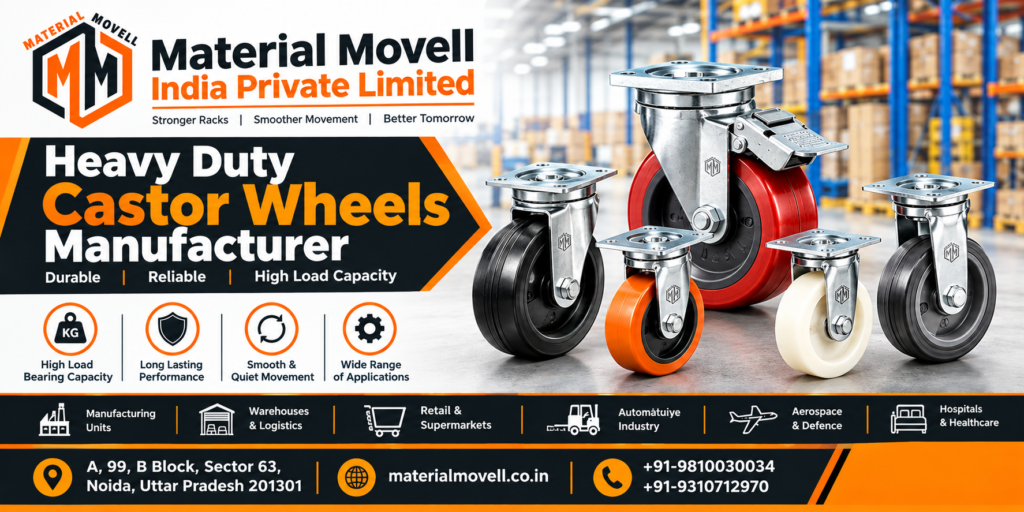
A castor wheel is a wheel-and-bracket assembly that attaches to the underside of equipment to allow it to be rolled from one location to another. A heavy duty castor is built to carry significantly greater loads — typically starting from a few hundred kilograms per wheel and going up to a few tonnes, depending on design — compared to light or medium-duty castors used on furniture or small carts.
Main components of a heavy duty castor include the wheel (tread and core), the bearing, the fork or yoke that holds the wheel, and the mounting arrangement (plate or stem) that attaches it to the equipment.
Load-bearing function: The wheel tread and core absorb and distribute the weight of the load as it rolls, while the fork and bearing manage the rotational movement (swivel) and keep the assembly stable under load. Heavier-duty designs typically use thicker fork walls, larger diameter wheels, and higher-grade bearings to handle sustained industrial use.
Standard vs. heavy duty castors: Standard castors are designed for lighter, intermittent use — think office chairs or retail display units. Heavy duty castors are built for continuous industrial movement of substantial loads, often on rougher floor surfaces, and are constructed with reinforced forks, larger wheel diameters, and industrial-grade wheel materials such as polyurethane, cast iron, or forged steel.
Industries use heavy duty castors wherever equipment, racks, or trolleys need to be repositioned without lifting — reducing manual handling effort and improving workflow efficiency across warehouses, manufacturing units, and logistics operations.
Types of Heavy Duty Castor Wheels
Swivel Heavy Duty Castors
Swivel castors rotate 360 degrees around a vertical axis, allowing equipment to be turned and manoeuvred in tight spaces. They’re commonly used on trolleys and carts that need directional flexibility, especially in aisles and workstations where frequent turning is required.
Fixed Heavy Duty Castors
Fixed castors roll only in a straight line and don’t swivel. They’re typically paired with swivel castors on the same trolley (two fixed, two swivel) to provide directional stability during straight-line movement of heavy loads, particularly over longer distances.
Heavy Duty Plate Castors
These castors attach via a flat mounting plate bolted to the underside of equipment. Plate mounting distributes load over a wider area and is common on industrial trolleys, workstations, and equipment stands where a stable, bolt-on fixing is preferred.
Polyurethane Heavy Duty Castors
Polyurethane (PU) wheels combine a hard core with a resilient PU tread, offering a good balance of load capacity, floor protection, and smooth rolling resistance. They’re widely used indoors on concrete, epoxy, or tiled floors where floor marking needs to be minimised.
Cast Iron Heavy Duty Castors
Cast iron wheels are solid, rigid, and capable of carrying very high loads, making them suitable for extremely heavy equipment. They perform well on smooth, hard floors but can be noisier and may mark softer flooring surfaces compared to polyurethane options.
Rubber Heavy Duty Castors
Rubber wheels offer good shock absorption and quieter operation, useful where floor protection and noise reduction matter. They tend to have somewhat lower load ratings than PU or cast iron equivalents of the same size, so load requirements should be checked carefully.
Stainless Steel Heavy Duty Castors
Stainless steel castors (frame and fork construction) are used where corrosion resistance is important — such as washdown areas, food processing zones, or humid environments — since standard steel components can rust under repeated moisture exposure.
Heavy Duty Castor Wheels: Key Components
| Component | Function |
| Wheel material | Determines load capacity, floor grip, noise level, and floor protection |
| Wheel diameter | Larger diameters generally roll easier and handle uneven floors better |
| Load capacity | The rated maximum weight the wheel can safely carry |
| Bearing | Reduces rolling resistance; ball or roller bearings suit heavier, frequent use |
| Fork/frame | Holds the wheel and transfers load from the equipment to the wheel |
| Mounting plate/stem | Fixes the castor to the equipment — plate or threaded stem, depending on design |
| Swivel mechanism | Allows directional rotation; quality affects manoeuvrability under load |
| Brake system | Locks the wheel to prevent movement during loading, unloading, or static use |
Applications of Heavy Duty Castor Wheels
Heavy duty castor wheels are used across a wide range of industrial settings, including:
- Material handling trolleys and hand-pushed carts
- Industrial carts used for transporting components or finished goods
- Heavy-duty storage racks that need repositioning
- Workstations and assembly benches requiring mobility
- Warehouse equipment such as pallet trucks and utility carts
- Manufacturing facilities moving semi-finished goods between stations
- Engineering and fabrication industries handling metal components
- Logistics and distribution centres for staging and sorting goods
- Industrial storage systems requiring occasional relocation
- General equipment and machinery movement within a facility
How to Choose the Right Heavy Duty Castor Wheels
Selecting the right castor involves more than checking a load rating on a spec sheet. Consider the following factors:
- Maximum load the equipment (fully loaded) will weigh
- Floor condition — smooth concrete, uneven, textured, or debris-prone
- Wheel material suited to the floor and environment
- Wheel diameter — larger wheels generally roll more easily and reduce operator effort
- Swivel vs. fixed configuration based on manoeuvrability needs
- Braking requirements for load stability during static use
- Operating environment — indoor, outdoor, washdown, or dusty conditions
- Temperature and chemical exposure that certain wheel materials tolerate better than others
- Frequency of movement — occasional relocation vs. continuous use
- Mounting requirements — plate size, bolt pattern, or stem type compatible with the equipment
Estimating load capacity per wheel: A simple starting formula is:
Required capacity per wheel = (Total load + equipment weight) ÷ Number of wheels × Safety factor
For example, a 4-wheel trolley carrying a combined load of 800 kg would need each wheel rated for at least 200 kg before applying a safety margin. In practice, load distribution is rarely perfect even — corners, uneven floors, and dynamic movement (starting, stopping, turning) can shift more weight onto individual wheels. Most suppliers recommend applying a safety factor and rounding up to the next available load rating rather than selecting the exact calculated figure. Actual selection should always account for these real-world operating conditions rather than the theoretical average alone.
Heavy Duty Castor Wheels vs Standard Castor Wheels
| Factor | Heavy Duty Castors | Standard Castors |
| Load capacity | Higher — built for substantial, sustained loads | Lower — suited to lighter, intermittent use |
| Durability | Reinforced fork and wheel construction for industrial wear | Lighter construction, less suited to continuous heavy use |
| Typical applications | Industrial trolleys, racks, manufacturing equipment | Office furniture, light retail or domestic use |
| Wheel construction | Thicker tread, larger core, industrial-grade bearings | Simpler construction, smaller bearings |
| Floor compatibility | Designed for rougher or uneven industrial floors | Best suited to smooth, even indoor floors |
| Operating conditions | Frequent, heavy-duty industrial movement | Occasional, light movement |
Benefits of Using Heavy Duty Castor Wheels
- Easier movement of heavy equipment without mechanical lifting aids
- Improved manoeuvrability in tight warehouse or factory aisles
- Reduced manual handling effort, lowering strain on operators
- Better overall equipment mobility across a facility
- Suitable load support when matched correctly to application requirements
- Reasonable long-term usability when the right wheel material and capacity are selected for the operating environment
Correct selection matters — a well-matched heavy duty castor, properly maintained, can perform reliably for extended industrial use, though actual service life will always depend on load conditions, floor surface, and usage frequency.
What Makes a Reliable Heavy Duty Castor Wheels Manufacturer?
When evaluating a manufacturer or supplier, buyers should look for:
- Clear, accurate product specifications (load capacity, dimensions, material)
- Transparent information on materials and construction methods
- Consistent manufacturing quality across batches
- Documented quality-control practices
- Genuine application knowledge — understanding how castors perform in different industrial settings
- Ability to offer customised sizes, plate patterns, or wheel materials
- Accessible technical support for selection queries
- Realistic delivery timelines for bulk or project orders
- After-sales assistance for replacement parts or troubleshooting
Why Choose Material Movell India Private Limited?
Material Movell India Private Limited, based in Noida, Uttar Pradesh, manufactures and supplies castor and trolley wheels alongside related material-handling products such as industrial racking and conveyor components. The company’s product range spans multiple wheel materials — including rubber, polyurethane, and steel construction — catering to varied industrial load and floor requirements.
For businesses looking for a heavy duty castor wheels manufacturer in India, working with a supplier that also understands adjacent material-handling equipment — such as racks and conveyor systems — can simplify sourcing for connected warehouse and factory setups.
If you’re specifying castors for a new trolley, upgrading equipment mobility, or replacing worn wheels on existing racks, reach out to Material Movell India Private Limited with your load, floor, and application details to discuss suitable castor-wheel options.
Frequently Asked Questions
What load capacity should I look for in a heavy duty castor wheel?
It depends on your equipment’s total loaded weight divided across the number of wheels, with a safety margin added for uneven load distribution. Always check the manufacturer’s rated capacity per wheel rather than assuming.
What’s the difference between swivel and fixed castors?
Swivel castors rotate 360 degrees for manoeuvrability, while fixed castors roll only in a straight line for directional stability. Most heavy-duty trolleys use a combination of both.
Which wheel material is best for concrete floors?
Polyurethane wheels generally perform well on concrete, offering a balance of load capacity, smooth rolling, and floor protection. Cast iron can also be used on smooth, hard concrete where very high loads are involved.
Can heavy duty castor wheels be used outdoors?
Yes, but wheel material should be selected for outdoor conditions — rubber or PU wheels with weather-resistant components handle uneven or exposed surfaces better than wheels designed strictly for indoor use.
Do heavy duty castors need brakes?
Brakes are recommended wherever equipment needs to stay stationary during loading, unloading, or operator use, to prevent unintended movement.
How often should castor wheels be inspected or replaced?
Inspection frequency depends on load, usage intensity, and floor conditions. Wheels showing wear, flat spots, or bearing play should be assessed and replaced as needed to maintain safe operation.
Contact us :- https://materialmovell.co.in/contact-us/