Material Movell

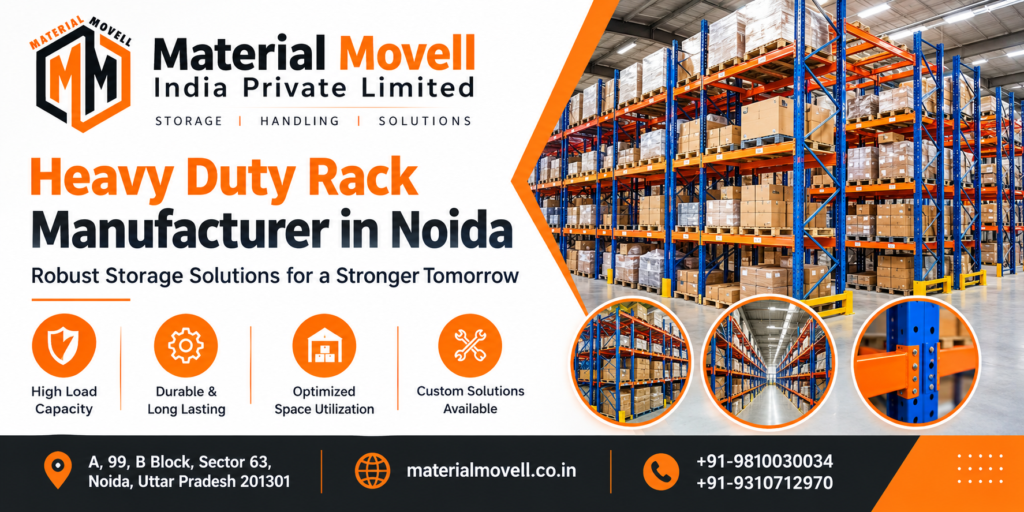
Heavy Duty Rack Manufacturer in Noida

Heavy Duty Rack Manufacturer in Noida: Complete Guide to Industrial Storage Solutions

Every warehouse, factory and distribution centre eventually runs short of floor space. Goods pile up in aisles, picking slows down, and safety suffers. Well-planned heavy-duty racks fix this by moving storage upwards, keeping inventory organised and making material handling smoother. If you are searching for a Heavy Duty Rack Manufacturer in Noida, this guide explains the rack types available, where each is used, how to evaluate a supplier and what shapes the final quotation. Quick Answer A heavy duty rack manufacturer designs and fabricates steel racking that safely stores heavy, bulky or palletised goods. When choosing one in Noida, check load capacity, material quality, layout fit, forklift compatibility, installation support and customisation options before you compare prices. What Is a Heavy-Duty Storage Rack? A heavy-duty storage rack is a structural steel system built to hold loads that ordinary shelving cannot carry. Typical parts include upright frames, horizontal beams or supports, bracing and shelf decking. Each part is sized for the weight it must carry. The right design depends on four things: Two warehouses of the same size can need very different racks. A spare-parts store picking small cartons by hand has little in common with a plant storing palletised raw material for forklifts. Types of Heavy-Duty Industrial Racks Buyers meet several racking styles when they shop for industrial racking systems. The table compares the common ones in general terms. Rack type Best suited for Practical advantage Main limitation Heavy-duty pallet rack Palletised and bulky goods High load capacity per level Needs forklift aisles Selective pallet racking Mixed stock with many SKUs Direct access to every pallet Lower storage density Drive-in racking Large volumes of the same item High density, fewer aisles Last-in, first-out access Multi-tier racking / mezzanine Sites with height but limited floor area Adds working or storage levels Needs structural planning Slotted angle or FIFO rack Components, cartons, spare parts Flexible adjustment, ordered stock rotation Lower capacity than pallet racks These are general categories, not a product list. Material Movell’s website currently lists Heavy Duty Rack, Slotted Angle Rack, FIFO Rack and Mezzanine Floor under its industrial racks category. For pallet, drive-in or other configurations, ask the team directly whether they can supply them. Benefits of Heavy-Duty Racks for Warehouses and Factories A properly specified racking system can support daily operations in several ways: Safety benefits too. Goods stored on rated racks are less likely to be stacked unsafely on the floor. How to Choose a Heavy Duty Rack Manufacturer in Noida Noida and the wider NCR region have many fabricators. A structured checklist makes comparison fairer. 1. Load capacity and configuration Share the weight of the heaviest pallet or item, the number of levels and the bay width. A good supplier will ask for these details before quoting. 2. Material quality and specification Ask for the steel grade, thickness and finish in writing. Powder coating or similar protective finishes matter in humid or dusty settings. 3. Space, layout and handling equipment Check ceiling height, column positions and aisle width. Confirm the rack suits your forklift or pallet truck turning radius. 4. Installation, inspection and maintenance Find out who installs the racks and who inspects them afterwards. Beams, uprights and base plates should be checked regularly for damage or loosening. 5. Customisation and after-sales support Industrial plants rarely fit standard dimensions. Ask whether custom industrial storage racks are possible and who handles later changes. 6. Documentation and safety practice Request drawings, load charts and installation guidance. Clear load-capacity labelling for each bay is a basic safety practice. Tip: visit the supplier’s work or request a site discussion before placing a bulk order. Applications of Heavy-Duty Storage Racks Heavy-duty racks for factories and warehouses are used wherever weight, volume or variety makes floor storage impractical: Practical example: a component maker may keep bulky castings on heavy-duty racks near the line, and small fasteners on slotted angle racks near the packing area. The rack type follows the item, not the other way round. Why Consider Material Movell India Private Limited? Material Movell India Private Limited is a Noida-based industrial manufacturer. Its website describes a company founded in 1975 by Mr. Ashok Khandelwal, with a Noida Sector 63 company established in 1999. It is best known for castors, caster wheels and trolley wheels, and it also offers industrial racks. Here is what the website states that is relevant to storage buyers: For storage buyers in Noida, that combination of a local presence and an industrial rack range makes the company worth shortlisting. Share your load, space and handling details, and ask the team to confirm what it can supply for your project. Factors Affecting Heavy-Duty Rack Selection and Cost No honest supplier can quote a rack without specifications. These factors move the final price: Factor Why it affects the quotation Dimensions Larger bays and taller racks use more steel Load specification Higher capacity needs heavier sections and bracing Material and thickness Steel grade and gauge change strength and weight Finish Powder coating or other coatings add protection and cost Storage configuration Levels, bay count and accessories alter the design Installation Site access, height and working conditions matter Order quantity Bulk orders may be priced differently Prices are not stated here because they depend on your exact requirement. Browse the Industrial Racks category to see the range, view the Heavy Duty Rack and Slotted Angle Rack pages, or use the contact page to request a quote. Frequently Asked Questions What does a heavy duty rack manufacturer in Noida do? It designs, fabricates and supplies steel racking for heavy or bulky goods, usually to suit the buyer’s load, space and handling equipment. Which heavy-duty rack is best for a warehouse? It depends on stock and equipment. Pallet racks suit forklift-handled goods, while slotted angle or FIFO racks suit lighter components and cartons. How do I know the right load capacity? Weigh your heaviest loaded pallet or item, then ask the manufacturer to size the beams and uprights with a suitable safety margin.

Heavy Duty Rack Manufacturer in Noida: Complete Guide to Industrial Storage Solutions Read More »
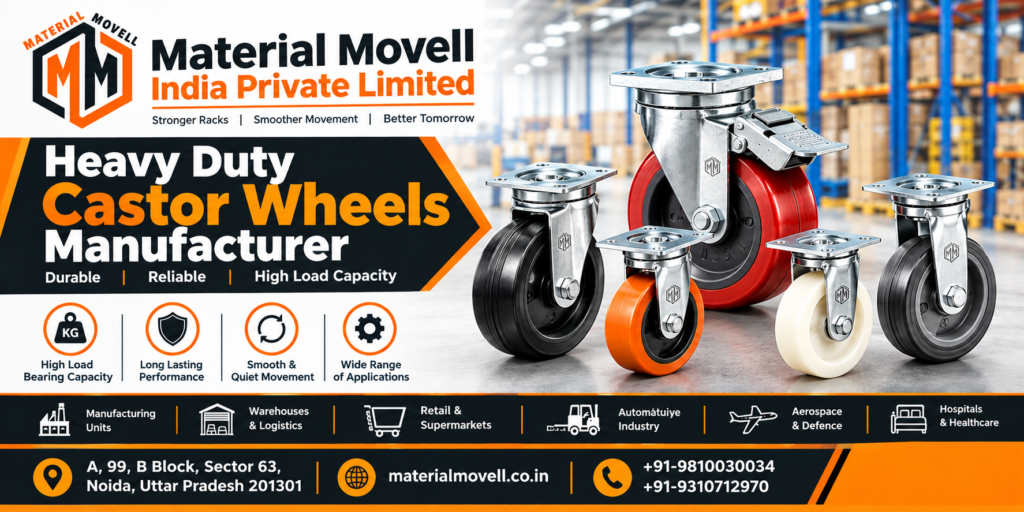
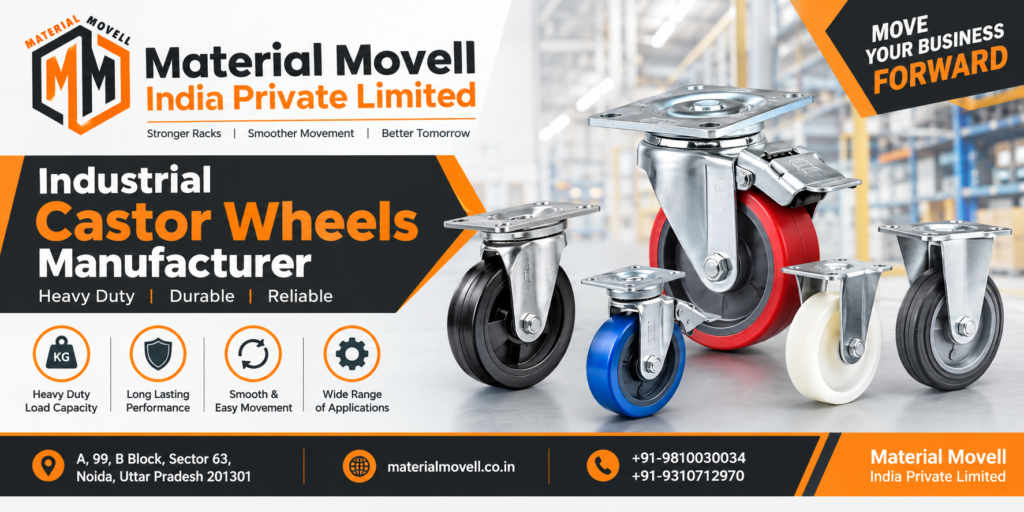
Heavy Duty Castor Wheels Manufacturer

Heavy Duty Castor Wheels Manufacturer | Types & Applications

Quick Answer: Heavy duty castor wheels are load-rated wheel assemblies mounted with a swivel or fixed fork, used to move heavy machinery, trolleys, and industrial equipment across warehouse and factory floors. When selecting one, buyers should evaluate load capacity per wheel, wheel material, floor surface, swivel vs. fixed configuration, and braking needs before finalising a supplier. Moving heavy loads safely across a factory floor or warehouse aisle depends on one small but critical component: the castor wheel. A heavy duty castor wheel is engineered to carry substantially higher loads than a standard-duty castor, without compromising rolling ease, floor safety, or long-term stability. Choosing the wrong castor — whether undersized, made from the wrong material, or unsuited to the floor surface — can lead to premature wheel failure, difficulty in manoeuvring, and even safety risks for operators. This guide covers what heavy duty castor wheels are, the common types available, their key components, typical applications, and a practical framework for selecting the right castor for your equipment. It’s written for procurement teams, plant engineers, and warehouse managers evaluating a Heavy Duty Castor Wheels Manufacturer for trolleys, racks, workstations, and material handling equipment. What Are Heavy Duty Castor Wheels? A castor wheel is a wheel-and-bracket assembly that attaches to the underside of equipment to allow it to be rolled from one location to another. A heavy duty castor is built to carry significantly greater loads — typically starting from a few hundred kilograms per wheel and going up to a few tonnes, depending on design — compared to light or medium-duty castors used on furniture or small carts. Main components of a heavy duty castor include the wheel (tread and core), the bearing, the fork or yoke that holds the wheel, and the mounting arrangement (plate or stem) that attaches it to the equipment. Load-bearing function: The wheel tread and core absorb and distribute the weight of the load as it rolls, while the fork and bearing manage the rotational movement (swivel) and keep the assembly stable under load. Heavier-duty designs typically use thicker fork walls, larger diameter wheels, and higher-grade bearings to handle sustained industrial use. Standard vs. heavy duty castors: Standard castors are designed for lighter, intermittent use — think office chairs or retail display units. Heavy duty castors are built for continuous industrial movement of substantial loads, often on rougher floor surfaces, and are constructed with reinforced forks, larger wheel diameters, and industrial-grade wheel materials such as polyurethane, cast iron, or forged steel. Industries use heavy duty castors wherever equipment, racks, or trolleys need to be repositioned without lifting — reducing manual handling effort and improving workflow efficiency across warehouses, manufacturing units, and logistics operations. Types of Heavy Duty Castor Wheels Swivel Heavy Duty Castors Swivel castors rotate 360 degrees around a vertical axis, allowing equipment to be turned and manoeuvred in tight spaces. They’re commonly used on trolleys and carts that need directional flexibility, especially in aisles and workstations where frequent turning is required. Fixed Heavy Duty Castors Fixed castors roll only in a straight line and don’t swivel. They’re typically paired with swivel castors on the same trolley (two fixed, two swivel) to provide directional stability during straight-line movement of heavy loads, particularly over longer distances. Heavy Duty Plate Castors These castors attach via a flat mounting plate bolted to the underside of equipment. Plate mounting distributes load over a wider area and is common on industrial trolleys, workstations, and equipment stands where a stable, bolt-on fixing is preferred. Polyurethane Heavy Duty Castors Polyurethane (PU) wheels combine a hard core with a resilient PU tread, offering a good balance of load capacity, floor protection, and smooth rolling resistance. They’re widely used indoors on concrete, epoxy, or tiled floors where floor marking needs to be minimised. Cast Iron Heavy Duty Castors Cast iron wheels are solid, rigid, and capable of carrying very high loads, making them suitable for extremely heavy equipment. They perform well on smooth, hard floors but can be noisier and may mark softer flooring surfaces compared to polyurethane options. Rubber Heavy Duty Castors Rubber wheels offer good shock absorption and quieter operation, useful where floor protection and noise reduction matter. They tend to have somewhat lower load ratings than PU or cast iron equivalents of the same size, so load requirements should be checked carefully. Stainless Steel Heavy Duty Castors Stainless steel castors (frame and fork construction) are used where corrosion resistance is important — such as washdown areas, food processing zones, or humid environments — since standard steel components can rust under repeated moisture exposure. Heavy Duty Castor Wheels: Key Components Component Function Wheel material Determines load capacity, floor grip, noise level, and floor protection Wheel diameter Larger diameters generally roll easier and handle uneven floors better Load capacity The rated maximum weight the wheel can safely carry Bearing Reduces rolling resistance; ball or roller bearings suit heavier, frequent use Fork/frame Holds the wheel and transfers load from the equipment to the wheel Mounting plate/stem Fixes the castor to the equipment — plate or threaded stem, depending on design Swivel mechanism Allows directional rotation; quality affects manoeuvrability under load Brake system Locks the wheel to prevent movement during loading, unloading, or static use Applications of Heavy Duty Castor Wheels Heavy duty castor wheels are used across a wide range of industrial settings, including: How to Choose the Right Heavy Duty Castor Wheels Selecting the right castor involves more than checking a load rating on a spec sheet. Consider the following factors: Estimating load capacity per wheel: A simple starting formula is: Required capacity per wheel = (Total load + equipment weight) ÷ Number of wheels × Safety factor For example, a 4-wheel trolley carrying a combined load of 800 kg would need each wheel rated for at least 200 kg before applying a safety margin. In practice, load distribution is rarely perfect even — corners, uneven floors, and dynamic movement (starting, stopping, turning) can shift more weight onto individual wheels. Most suppliers recommend

Heavy Duty Castor Wheels Manufacturer | Types & Applications Read More »

Industrial Castor Wheels Manufacturer

Industrial Castor Wheels Manufacturer | Heavy Duty Wheels

If a wheel fails under load, the cost is never just the wheel. It’s a stalled production line, a damaged floor, a spilled load, or an injured worker. That’s why choosing the right Industrial Castor Wheels Manufacturer matters more than most procurement teams realize — the wheel is a small component with an outsized impact on plant safety and uptime. At Material Movell, we’ve been manufacturing heavy duty industrial castor wheels and trolley wheels in India since 1975, and we’ve seen firsthand how the right castor selection prevents downtime, reduces maintenance costs, and keeps material handling operations running smoothly. This guide walks through everything a factory owner, procurement manager, or maintenance engineer needs to know before buying industrial caster wheels — from load calculations to material selection to common failure points. What Are Industrial Castor Wheels? Industrial castor wheels are wheel-and-bracket assemblies designed to be mounted under trolleys, carts, workstations, machinery, and equipment so they can be moved with minimal effort. Unlike standard furniture or light-duty casters, industrial trolley wheels are built to carry significant weight repeatedly, across long shifts, often on rough or uneven factory floors, without breaking down. A castor assembly typically consists of: Every one of these components affects how the castor performs under load, and a weak link anywhere in this chain leads to premature failure. Why the Right Manufacturer Matters More Than the Lowest Price Many procurement teams shop industrial castor wheels purely on unit price. This is where most costly mistakes happen. A castor priced 15% lower but rated for a lower load capacity, made with inferior bearing steel, or using low-grade polyurethane, will typically fail within months in continuous-use environments — leading to replacement costs, unplanned downtime, and in worse cases, safety incidents. A genuine industrial wheels manufacturer should be able to answer these questions confidently: At Material Movell, our castors are manufactured in-house across our Noida, Roorkee, and Greater Noida facilities — including an automatic CED (Cathodic Electro Deposition) coating plant for enhanced corrosion resistance on metal components. This vertical integration lets us control quality at every stage, from raw sheet metal and forging to final assembly, rather than outsourcing critical components to third parties. Types of Heavy Duty Castor Wheels Not aoor surface, speed of movement, and environmental conditions. 1. Fixed vs. Swivel Castors 2. Wheel Material Types Wheel Type Best For Key Property Cast Iron / Steel Extremely heavy static or slow-moving loads Maximum load capacity, low rolling resistance Polyurethane (PU) General industrial and warehouse use High load capacity, floor-friendly, quiet Elastomer / Rubber Uneven floors, shock absorption Cushioned ride, noise reduction Nylon Chemical or moisture-heavy environments Corrosion resistant, durable in harsh conditions Cast Polyurethane on Aluminium Core (ALCPU) High-load trolleys needing durability with lighter weight Combines strength of metal core with cushioning of PU tread 3. Spring-Loaded / Shock-Absorbing Castors For applications where loads travel over uneven flooring, expansion joints, or dock plates, heavy load castor wheels with a spring-loaded or forged shocker mechanism absorb impact and protect both the load and the floor from repeated shock stress. How to Choose the Right Industrial Castor Wheels Selecting castors for industrial equipment correctly the first time avoids costly replacements later. Use this framework: Step 1: Calculate the Actual Load Add the weight of the equipment/trolley itself to the maximum expected load, then divide by the number of castors — but never assume equal weight distribution. As a safety margin, select castors rated for at least 25–30% above your calculated per-wheel load, since uneven weight distribution and dynamic movement (starting, stopping, turning) increase actual stress on individual wheels. Step 2: Assess the Floor Surface Step 3: Consider the Operating Environment Temperature extremes, chemical exposure, and moisture all degrade certain materials faster. Industrial material handling wheels used in cold storage, for example, need wheel compounds rated for low-temperature flexibility, while wheels in chemical plants need corrosion-resistant brackets and non-reactive tread materials. Step 4: Match Wheel Diameter to Movement Ease Larger diameter wheels roll more easily over floor irregularities and require less pushing force — a critical factor for manual trolleys handled by workers across long shifts. Smaller wheels suit tighter spaces but increase rolling resistance. Step 5: Decide on Braking Requirements Any application involving loading/unloading, height-adjustable workstations, or use near ramps and inclines should include braked castors to prevent unintended movement. Common Applications of Heavy Duty Wheels Heavy duty wheels and industrial castors are used across nearly every sector that moves physical goods: Because usage patterns differ so widely, industrial castor wheels for material handling should always be specified for the actual application rather than picked from a generic catalog listing. Signs Your Industrial Castors Need Replacement Waiting until a wheel fails completely often causes secondary damage. Watch for: Proactive replacement based on these signs is far cheaper than the downtime and potential safety risk of an in-service failure. Why Choose Material Movell as Your Industrial Castor Wheels Manufacturer Material Movell India Pvt. Ltd. was founded on the principle of producing wheels and castors that exceed expectations on both quality and performance. Over five decades, that has translated into: Whether you need a single trolley wheel replacement or a bulk order for a new production line, our team works directly with procurement managers and engineers to match the right castor to the right application. Frequently Asked Questions What is the difference between a castor wheel and a regular wheel?  A castor wheel includes the wheel plus a mounting mechanism (fork, plate, or stem) that allows it to swivel or roll in a fixed direction. A regular wheel is just the rolling component and requires a separate axle mounting. What load capacity do heavy duty industrial castor wheels typically carry?  Depending on wheel material, diameter, and bearing type, heavy duty industrial castors can range from around 200 kg to over 5,000 kg per wheel. Always confirm the manufacturer’s rated capacity for your specific model rather than assuming based on wheel size alone. Which wheel material is best for heavy loads on concrete

Industrial Castor Wheels Manufacturer | Heavy Duty Wheels Read More »

Tesing Blog Page

Premium Medium Duty Fixed Castor (Pressed Steel) with Polypropylene Wheel for Industrial Material Handling Material Movell (India) Pvt. Ltd. offers premium-quality Medium Duty Fixed Castor (Pressed Steel) with Polypropylene Wheel designed to provide reliable straight-line movement, superior load-bearing capacity, and long-lasting durability for medium-duty industrial and commercial applications. Manufactured using premium pressed steel brackets and high-strength polypropylene wheels, these fixed castors ensure smooth transportation, excellent stability, and dependable performance in warehouses, manufacturing units, retail facilities, hospitals, and logistics centers. Unlike swivel castors, fixed castors are specially designed to move only in a straight direction, providing greater stability while transporting goods over longer distances. Their rigid construction minimizes unnecessary movement, making them ideal for platform trolleys, industrial carts, storage racks, production equipment, and material handling systems where directional control is essential. Material Movell Medium Duty Fixed Castors are precision manufactured using advanced production technology and strict quality control standards to ensure maximum strength, corrosion resistance, dimensional accuracy, and long operational life under continuous industrial usage.

Tesing Blog Page Read More »

Scroll to Top